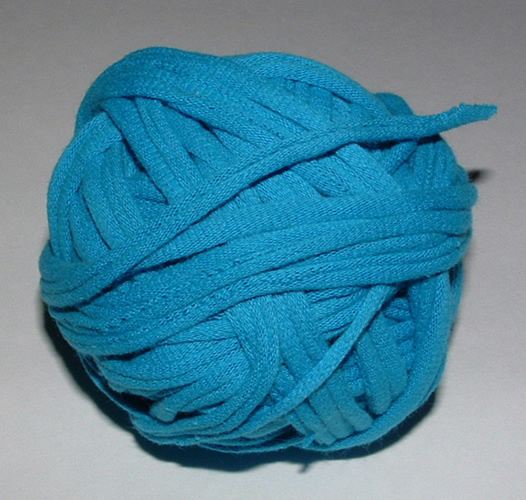
 This is a tutorial on how to make T-yarn from old recycled tee-shirts. T-yarn maybe a new term to you. T-yarn or Tarn is what the yarn is being called that is made from cutting t-shirts into strips for crafting.
The best t-shirts are ones that do not have side seams as you can cut around and around starting at the bottom. First cut off the hem and then with a sharp pair of scissors cut strips about 1/2″ to 3/4″ wide. Cut in one continuous strip as I have shown here.
All photos are clickable to supersize them


I stopped at the armhole openings as this was the end of my continuous strip that is completely one piece cut in rounds. You can cut off the sleeves and start another continuous strip at this point but it’s not as smooth as the main body because you will have curves in your strip where you have to turn the corners.

To create the circular T-yarn, you gently pull on the strip. I found the best way to do this is by taking a short length about 1-2 feet long and stretching it. The stretching causes the tee-shirt strip to turn in on itself thus creating your rounded T-yarn. One important warning is not to pull too hard otherwise the strip breaks. I did have this happen on my first attempts so be advised to gently pull on the strip until it won’t stretch any further. Then you move to the next section of your strand and stretch it again. Continue stretching your strip until the whole long continuous strand has been stretched and is curled as shown in the photo.
 Click to supersize
Here is a small sample of what the curled T-yarn looks like when you crochet with it. It’s smooth to work with and has a nice finished look. You can either crochet or knit with the recycled yarn that has been created. This circular T-yarn would make excellent potholders, trivets and of course is perfect for a recycled tote bag. One large tee-shirt netted about 90 yards of T-yarn once stretched. So grab your crochet hook or knitting needles and experiment with this recycled material to create some wonderful eco craft projects.
Oh my, Cindy, this is fantastic! I am going to try this as soon as I can rifle through some things and find an old t-shirt.
Looks much easier to work with than plarn, and I’m sure just as sturdy. Once it is rolled into itself and then crocheted, does it have any stiffness to it, or is it pretty flexible?
Marie Anne’s last blog post..Am I Hallucinating?
Oh yea, I just ‘tweeted’ this link on twitter. Hope it gets you a few hits!
Marie Anne’s last blog post..Am I Hallucinating?
@Marie Anne,
The yarn created from T-shirts is still soft and easy to work with. It is not stiff and is very flexible. I hope you will try a project with the t-yarn.
WOW what a great idea. I should totally do that so I can whip up a pillow in a hurry. Great job so far can’t wait to see the finally project.:)
Lesalicious’s last blog post..Before and After (Couch and Chair Remodel)
Great instructions! I just posted on my blog here what to do with the rest of the t-shirt.
This looks simplier than using plastic bags although I did make a door mat once. I have tons of old t shirts and can pick up more at yard sales for cheap. Great bag patterns too. THANKS!
I’m going to try this too. This is really cool. I wonder if the way I cut plastic bags might also cut t-shirts easily. I think it would save time.
Mary Anne – OMG! yard sales.
Recently I picked up a potholder loop kit to do with my kids. There was a book which had patterns and polyester loops for about 8 potholders. I made more than my daughter made because I was excited to try out the patterns. It turns out those things melt in high heat. I bought a bag of cotton loops and they are very hard to work with but make better potholders. I wonder if old t-shirts could be used somehow…
OK – you’ve given me another project!
I’ve got a pile of tee shirts that the whole family uses for nightshirts. That pile is going to get smaller now.
Thanks!
CrochetDad’s last blog post..We’re gonig to the Fair!
Absolutely, fantastic! I’m so excited about this technique. I can’t wait to try this. I was just looking at some t-shirts and thought of turning them into dust rags. But I crochet more than I dust. lol Thanks so much for this lesson.
I just made my first ball of t yarn out of a cool colored mismade green t shirt a friend left at my house before he moved away
I love this! I’m having a hard time finding t-shirts without seams though.
@Polly,
You don’t have to use seamless t-shirts but they do work better. When you cut a t-shirt that has side seams, just go around like you would if you were peeling an orange all in one continuous strip. Try and make the longest strip possible so you don’t have a lot of splices in your t-yarn.
I’m just now getting into crocheting with ‘tarn’ but wondered if you have any additional ideas on what to do with the top part of the t-shirt. After creating a bunch of balls, I still have a lot of scrap t-shirt fabric left that I would love to reuse in some way!
Thanks for such an informative blog!
Tina,
I still cut the top of the shirt and the back above the armholes. I do a long strip but going around the outside of the shirt, up around the neck and down the other side. At the corners, I do wide circular turns and trim the edges. This piece at the top isn’t as smooth as the lower portion that is cut and curled but is still usable. I save all the pieces and used them in areas that if the edges aren’t as smooth its not that noticeable. You can also use the top piece for pockets in handbags and as lining for purses. I’ve also used these pieces and the sleeves as dusting rags. Best wishes and thanks so much for stopping by for a visit at my blog.
Tina,
I still cut the top of the shirt and the back above the armholes. I do a long strip but going around the outside of the shirt and at the corners, I do wide circular turns and trim the edges. This piece at the top isn’t as smooth as the lower portion that is cut and curled but is still usable. I save all the pieces and used them in areas that if the edges aren’t as smooth its not that noticeable. You can also use the top piece for pockets into handbags and as lining. I’ve also used these pieces and the sleeves as dusting rags. Best wishes and thanks for much for stopping by for a visit at my blog.
What a terrific use for old T-shirts. If any of you has a serger, it is super simple to cut those long strips. Just set your machine without any thread, put on a seam guide if you have one, clip the fabric then continuously feed it through to make a long, even-width strip.
here is a website that uses the t-shirt sleeves for a t-shirt headband.http://zakkalife.blogspot.com/search/label/recycled%20crafts
Awesome. I’m grabbing my scissors right now and attacking all those t’s I never wear.
Just discovered your page, very interesting! I am from New South Wales, Australia. I will be checking out all your patterns.
I love the idea of using TARN . . .but I worried I won’t be able to cut all the strips the same size. Does that even matter?
@Teresa:
I like my t-shirt yarn narrow about 1/4″ wide and I try and cut it about that wide. I cut it laying on my lap and across my leg. I cut my strips up about a foot up and then move my piece and continue. The width really depends on what you are doing. I find the narrow tarn easier to crochet with.
Good information Cindy,
I had hesitated cutting my t-shirts that narrow thinking that it would just shred away. Obviously they don’t.
I am glad to read that you use the top too, but I thought there must be a more efficient method than the one I already use. Do you ever have problems with the surged shoulder seams giving away. (I haven’t but I worry everytime I wash something I made with shirts.)
Thank you
Clare
PS My husband thinks that there should be a better name than Tarn.
Clare:
Cutting the t-shirts thin makes the material more manageable when you crochet or knit with it. You do have to be careful when you stretch it not to pull too hard as it will break but the finished project is strong and is very durable to craft with. As for the seams, I cut along them and cut the strips only around each section if the t-shirt has side seams. I personally like referring to the yarn created from t-shirts as t-yarn but many people use the term “tarn” so it’s whatever you prefer to use when identifying this reclaimed material.
How do you recommend joining strips? is knotting too lumpy to work into the piece?
@Elaine,
You can use knots which I do sometimes if I can hide the knot easy in my project so it doesn’t show. You can also splice strips together by either hand or machine stitching the ends together.
Another method that doesn’t require sewing the strips together is to make a small slit hole at the end of the two strips you need to splice together. The slit should be cut lengthwise only about ½ inch from the end of the strip and should only be big enough to allow the next strip to pass through it. Hold the two strips with the holes together then take the uncut end and lace it through two holes. Pull the strip completely through the holes and pull tight to make the splice as small as possible.
One other method is to just overlap the two strips as you crochet but again it depends on the project if you can get away with hiding the overlapping area. Hope this helps. Best wishes and happy crafting to you.
I like the splice with the cuts in the ends – sounds like it would be a smoother join. Thanks for all these super ideas!
@Elaine,
Glad I could help. You might take a look at this t-shirt yarn tute on how to join. It shows how to do the joining with t-shirt strips.
I love this, and linked to you from my own fledgling blog 🙂
Thanks so much for explaining it so clearly!
.-= Samantha McNesby´s last blog ..Fun with Leftover Socks =-.
I make T-shirt quilts from my son’s favorite but outgrown or worn out shirts. This is a wonderful way to use the rest of the shirt (although it requires more piecing since the center of the front of the shirt is cut out).
What a genius you are! I want to do my part to recycle and what you are posting is exactly the answer! I am so gonna get started on it 😀
If you happen to have old cotton jersey sheets (maybe I’m the only one who loves those…), you could (theoretically) fold it in half lengthwise, and stitch up the other long side with a narrow seam (overlock it, if you can), creating a tube that could be cut in a continuous length, a al plarn from shopping bags… you’d get several hundred yards once it was stretched….
@SuperMolly:
I am actually cutting up a jersey sheet right now that I got at a thrift store for 25 cents. It’s making hundreds of yards of t-yarn. I’m cutting it in one continuous strip about 1/2 inch wide and then curling it. Working with t-yarn is heavier than plarn so you don’t need or really want the double strand of “yarn.”
Old t-shirts! Salvation Army is going to love me!!! Can’t wait to get started with this.
This is such a great idea! To think I’ve been buying yarn to make potholders! I volunteer at my church’s thrift store – now I know what to do with all those old T-shirts that don’t sell!
This is fantastic! I love re-cycling things. I do believe that I will be cutting some shirts soon and may be making me a bag for knitting anc crocheting out of the T-yarn.
Thank you for sharing this with us!
Cindy, what is the best size crochet hook to use? I’ve seen lots of Tarn rugs and am wanting to try one. TIA!
Anita:
If you cut your tarn real thin you can use a smaller hook like maybe
a H or J hook. If its wider then use an N (9mm) hook. You can use what feels
best for you and the stitch size you like.
Looking at your pictures, thinking what a waste of the top (if it’s in good condition, top + sleeves). Why not turn them into “shoulder-upper arm protectors” to protect against sunburn while wearing a bathing suit?
Crochet around edges, sleeves, decorate as desired, match swim suits. Could even add a “bottom trim” by using a lacy st (shell?)as many rows as desired.
Just a thought, that occurred to me.
@Doris — Oh I do use the whole t-shirt. I cut the top portion around and when I get to a corner I just do a wide curve in my t-yarn strip. The little tag that is created as just crocheted under when I get to it. It hides real well and you don’t see the curved area in the project.
I like your idea of using the top for a cover-up too. Great idea and you could add a bottom like you described. Thanks for stopping by and sending me a message.
For those who have a cutting board and a rotary cutter, you might want to try my “loopy” method. I do this with my plastic bags, usually 4-5 at a time, just stacked up. Don’t know if the stacking will work w tee shirts.
Cut straight across the tees, from side to side. Each cut will give you one round. When you’ve got enough, or just got tired, start looping the rounds together. Then just wind all this stuff up into a ball and start crocheting.
I’ve begun separating the white (or other solid color) rounds from the word/picture/logo/whatever rounds so I can make a solid white bag, and maybe have a yellow stripe around the top, or …..
There’s no reason why this won’t work with t-shirts as well as bags!
I love this idea! I have some old t-shirt sheet sets that I didn’t have the heart to get rid.
I can’t wait to try it. I’m not a expert at crocheting but that is definatly give me lots of yarn to practice with. Thanks!
I love the idea of the ‘tarn’ with the t-shirts. I recently lost a great deal of weight and have been donating my ‘big’ clothes. This would be a great project to do with my old t-shirts. A rug it is. Thank you for sharing your patterns and ideas!!!
I’ve found that it’s easier for me to cut the strips with a rotary cutter (using a quilting ruler) to keep the widths even. Just don’t cut all the way to the end of one side. Leave 2-3 inches uncut and use scissors to cut the final bit at an angle – so it’s a spiral instead of loops.
Heather,
Thanks for sharing your method of cutting. I haven’t tried a rotary cutter yet as I usually cut my t-yarn outside so the bits can shed outside. I just eyeball my width but try to keep it as uniform as possible as I cut. If the width gets off a bit, it’s okay as it works itself out as you crochet the item. If my t-shirt material has corners, I usually work an oval shaped cut at the corner and then just stretch and trim any edges as appear. This allows my t-yarn to be a continuously long piece of material.
I have a big t-shirt rug I am working on. I live near a thrift store that has t-shirts for a DIME every day. I have been cutting them and it causes big knots…..but after seeing the way you did grocery bags, I did the t-shirt the same way. Cut thin strips while keeping the *circle*…..and pulling them together and it turns into a ball of t-yarn! I’ve been struggling with the t-shirts up until NOW! I am SO glad I came to your blog today and learn a new trick. I get the t-shirts at such a good price, it’s hard to NOT buy them. ( I also buy the largest ones possible! they’re not for wearing, but for cutting!) Thanks.
Love all the helpful information. Guess it just made the light come on for me. Rather than cutting with scissors by hand those of you who have a serger just take out the needles and use the blades to cut your strips. Easy on the hands for those with arthritis or other hand/wrist issues that cut down working time. Not as environmental conscious as hand scissors [no hydro] but still helping to keep items out of the land fill.